Nasdaq follows Cboe joining world of ‘binary bets’ as prediction
Nasdaq Joins Binary Bets as Prediction Markets Boom
In 2026, Wall Street’s traditional financial infrastructure is undergoing a transformation that just a few years ago might have seemed unlikely: major exchanges are moving into the realm of prediction markets and binary outcome betting powered by real-time probabilities.
The latest notable development is that Nasdaq has filed with the U.S. Securities and Exchange Commission (SEC) seeking approval to launch binary event contracts — often called “Outcome-Related Options” — tied to its flagship index, the Nasdaq 100 and its micro index. These contracts will let traders essentially bet on yes-or-no outcomes related to future events, with pay-outs structured as all-or-nothing outcomes.
This move by Nasdaq follows similar initiatives from Cboe Global Markets, which is also pursuing approval to introduce “all-or-none” options on financial and economic events. Together, these actions mark a broader Wall Street shift that embraces prediction market mechanics — once mostly the domain of crypto platforms — in mainstream finance.
But what exactly are prediction markets? Why are traditional exchanges suddenly interested in them? And what are the implications for investors and markets? Let’s explore.
What Are Prediction Markets?
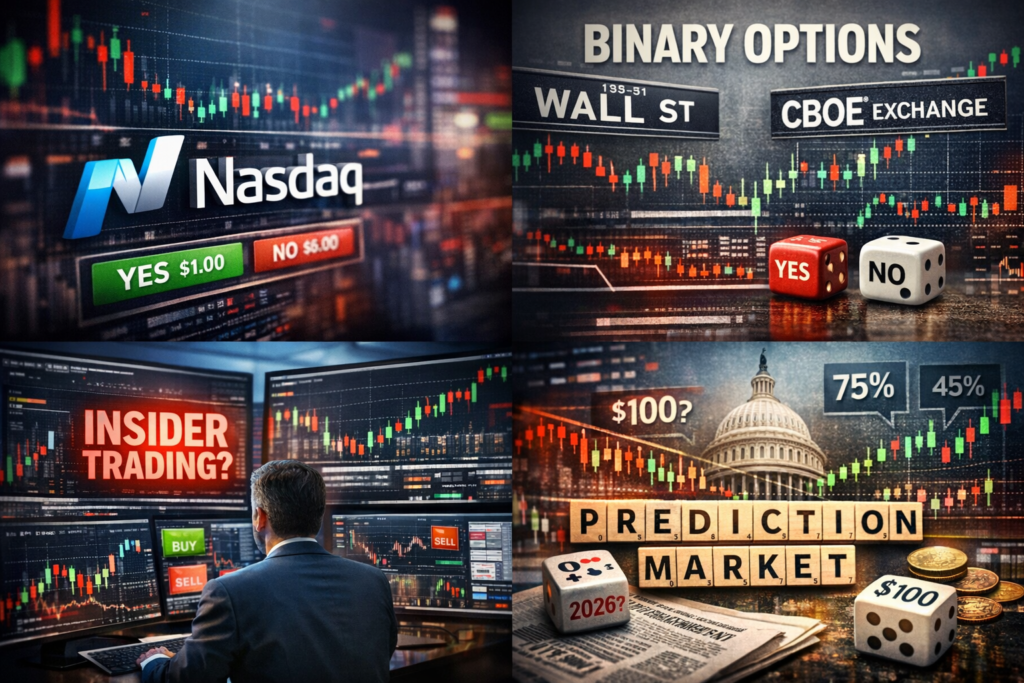
At their core, prediction markets are platforms where participants trade contracts tied to the outcomes of future events. These events can be political, economic, corporate, or even entertainment related. The trading prices of these contracts imply the market’s collective probability that a specific outcome will occur.
For example, on a typical prediction market:
- A contract might ask: “Will the U.S. jobs report exceed expectations this Friday?”
- Traders choose YES or NO.
- If the price of YES is 0.65 (or $0.65), that implies the market estimates a 65% chance of the outcome.
- If the event occurs, YES contracts settle at $1, while NO contracts settle at $0.
This structure turns collective forecasting into a financial market: participants put their money where their beliefs are, and prices adjust in real time as new information emerges.
From Crypto Niche to Mainstream Finance
Prediction markets first gained prominence in the crypto world, with platforms like Polymarket allowing users to bet on political outcomes, economic events, and even world affairs. These decentralized markets became well-known after processing billions of dollars in bets during major events such as the 2024 U.S. presidential election.
Crypto-based prediction markets drew traction because they:
- Offered transparent probabilities of real-world events.
- Used blockchain infrastructure for automated settlement.
- Were accessible globally.
Traditional finance watched these developments closely. As trading volumes increased — surpassing $3 billion in revenue run rates with projections possibly hitting $10 billion by 2030 — prediction markets began to attract institutional attention.
This popularity is now spilling back into regulated markets, with Nasdaq and Cboe leading the mainstream charge.
Nasdaq’s Proposal: Bringing Binary Bets to a Major Index
On March 2, 2026, Nasdaq formally filed a proposal with the SEC to introduce “Outcome-Related Options” — binary contracts priced between 1 cent and $1 — tied to its main indices, including the Nasdaq 100 and its micro version. These contracts are essentially binary bets where the payout depends wholly on whether a defined event happens or not.
For instance:
- Traders might bet whether the Nasdaq 100 will close above a certain level by a specific date.
- If it does, the contract pays out at its full value.
- If not, it expires worthless.
This binary structure straightaway evokes comparison with crypto prediction markets — but under the Nasdaq proposal, these would be offered through a regulated exchange framework overseen by the SEC.
Nasdaq’s executives have emphasized they plan a cautious rollout, starting with their own index products before expanding. Their move signals confidence that prediction markets have moved past novelty into legitimate trading instruments.
Cboe and Competition in Prediction Contracts
Nasdaq proposes binary options priced between $0.01 and $1 to compete with prediction markets and offer regulated short-term bets on the Nasdaq. This indicates a broader competitive trend, with major exchanges looking to capture both retail and institutional demand.
The competition between Nasdaq, Cboe, and other traditional players may help drive innovation in the design of prediction contracts, widen available event types, and expand liquidity — all key components needed for a healthy market ecosystem.
Why Wall Street Is Embracing Prediction Markets Now
1. Institutional Demand for Real-Time Probabilities
Traditional analysts and asset managers have long relied on models, surveys, and expert opinions. Prediction markets provide dynamic, market-based probability estimates that update with new information in real time — something static models cannot match.
2. Expansion Beyond Crypto
Regulated prediction markets bridge the gap between blockchain-native platforms and mainstream trading infrastructure. As crypto platforms like Polymarket partner with major financial media outlets to distribute their data, markets increasingly view this information as useful financial signals.
3. Trading Volume and Revenue Potential
With billions in annualized trading volume and high user engagement, prediction markets represent a growing revenue stream. Traditional exchanges are motivated to integrate these products into their existing trading ecosystems.
4. Hedging and Risk Management
Prediction markets aren’t purely speculative; many institutional players see them as hedging tools. Traders can use event probability markets to hedge interest rate outcomes, inflation announcements, or key economic data releases.
Regulatory Challenges and Scrutiny
Despite the excitement, bringing prediction markets to regulated financial venues is complex.
Insider Trading & Integrity Concerns
Prediction markets face ongoing scrutiny regarding potential insider trading. Platforms like Kalshi have already suspended and fined users who allegedly traded on non-public information. These enforcement actions highlight how insider knowledge — such as a candidate trading on their own election chances — can undermine fair market conditions.
Even Polymarket, which operates in a legal gray area for some events, has drawn regulatory and ethical questions. Recent coverage has focused on high-profile trades tied to geopolitical developments, raising concerns about fairness and market manipulation.
Dual Regulatory Landscape
In the U.S., prediction markets often straddle the line between derivatives and gambling. Platforms must navigate rules from the Commodity Futures Trading Commission (CFTC) and the SEC, and state-level issues complicate compliance.
Nasdaq and Cboe are moving into this space — but only with careful regulatory engagement, making sure their offerings align with securities laws. Their moves could set precedents for how these products are supervised and marketed.
Risks, Benefits, and the Future of Prediction Markets
Prediction markets offer both risks and opportunities:
Pros
- Efficient aggregation of collective intelligence — markets reflect crowd probabilities.
- Real-time updates — unlike static forecasts, prices adjust with new data.
- Hedging possibilities — uses beyond pure speculation.
- New revenue streams — for exchanges and traders alike.
Cons
- Insider trading risk — information asymmetry is a major concern.
- Regulatory uncertainty — evolving frameworks could slow adoption.
- Potential for misuse — markets around sensitive events can raise ethical questions.
How Prediction Markets Could Influence Finance
If Nasdaq and Cboe gain approval and launch their binary event products, prediction markets may become integrated into broader financial strategies:
1. Complement Traditional Forecasting
Investors might use probability prices as another input alongside earnings forecasts, economic data, and analyst models.
2. Attract New Traders
Retail traders interested in simplified yes-or-no outcomes could find these markets more accessible than traditional derivatives.
3. Bridge Between Crypto and TradFi
Regulated prediction markets could bring institutional crypto traders and traditional finance managers closer together, unifying insights from both sectors.
Conclusion: A Mainstream Turning Point
Wall Street’s embrace of prediction markets marks a pivotal moment in financial innovation. What started as niche, crypto-centric tools — platforms where traders bet on elections, sports, and economy — are now poised to enter regulated exchange offerings from Nasdaq, Cboe, and beyond.
Whether these markets will fulfill their promise — providing accurate, fair, and useful probability signals — will depend on regulatory rigor, technology design, and investor adoption. But one thing is clear: prediction markets have moved from fringe to front and center in the financial world.
For traders, analysts, and investors alike, this trend opens a new frontier of opportunity and risk — one where the future isn’t just forecasted, it’s priced in real time.